Morocco - north Africa
prep: 20 min - Cooking: 40 min
-
Featured in the book Délices du Maroc, this recipe by Chef Abdelmalek El Meraoui originates from Souira, a coastal town near Agadir.
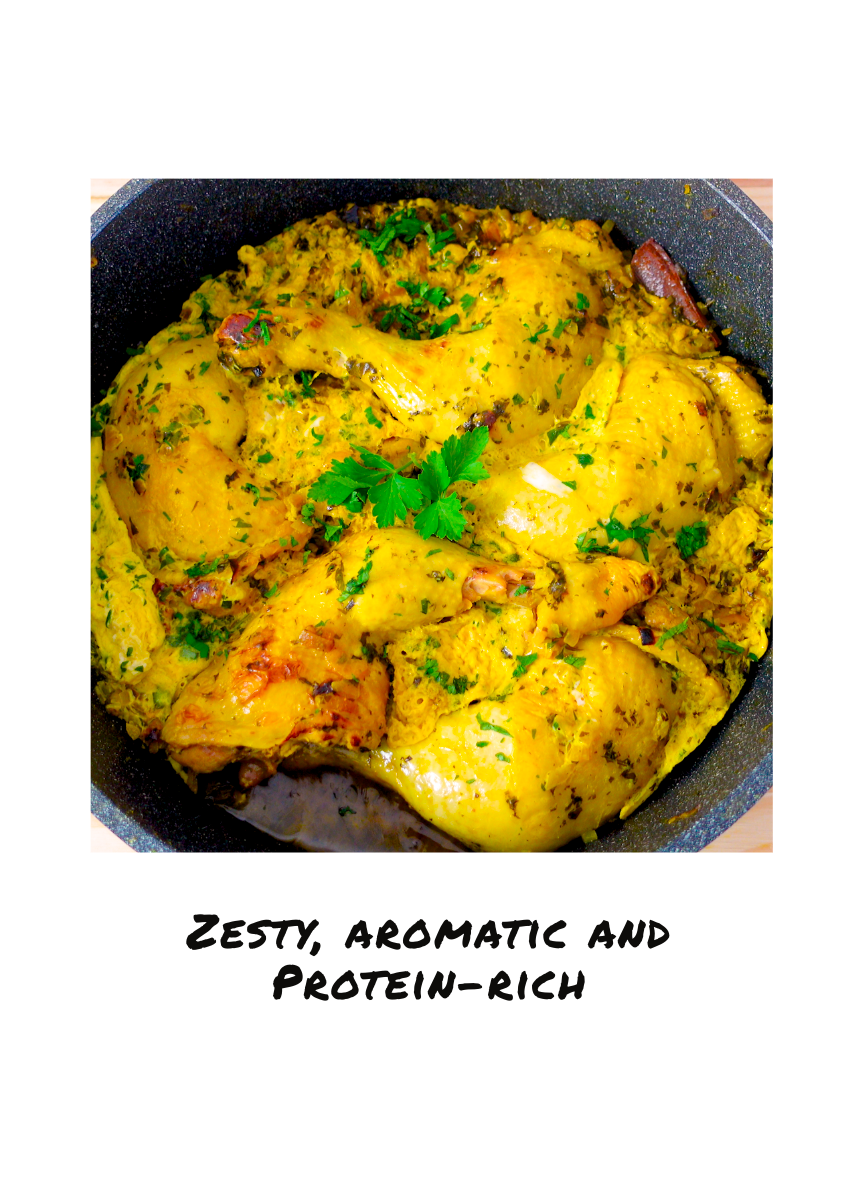
What sets this tagine apart is its finishing technique: during the final ten minutes of slow simmering in a savory lemon, saffron, and cinnamon onion gravy, a mixture of beaten eggs and fresh parsley is poured over the chicken, creating a soft and fluffy egg gratin.
Equipment Note: It's common to prepare the entire dish in a classic clay tagine and bring it straight to the table. I used a tagine that's not entirely traditional, but it works brilliantly for induction hobs and for anyone unused to cooking with clay. A Dutch oven or deep pan with a lid would work just as well.
Ingredients
For 5 Servings
5 chicken thighs
1 onion
50 ml olive oil
½ bunch parsley
½ bunch coriander
5 garlic cloves
1 pinch ground ginger (about 1g)
3–4 cinnamon sticks
1 teaspoon ground saffron (about 5g)
Juice of 1 fresh lemon
Salt (about 5g)
Black pepper (about 1g)
4 eggs
1 teaspoon olive oil
Here is how I Made IT
1. Finely chop the onion, garlic, parsley, and coriander.
Onion, garlic, parsley, coriander
2. Heat a tsp of olive oil in your tagine (or deep pan) over medium heat. Add the chopped onions and leave them to soften until translucent.
Olive oil, onion
3. Nest the chicken thighs into the softened onions.
Chicken thighs
4. Scatter over the garlic, chopped coriander, and half of the chopped parsley (reserving the other half for the eggs and garnish). Season with the salt and black pepper.
Garlic, coriander, parsley, salt, black pepper
5. Add the ground ginger, saffron, cinnamon sticks, and freshly squeezed lemon juice. Stir gently with a spatula to coat the chicken in the aromatics.
Ground ginger, saffron, cinnamon sticks, lemon juice
6. Cover with the lid and leave to simmer over low-medium heat for 30 minutes, letting the chicken release its juices and soak up the spiced sauce.
7. In a small bowl, whisk the eggs with the remaining chopped parsley, keeping a little aside for serving. Pour the egg mixture over the chicken, cover again, and cook for around 10 minutes, until the eggs are gently set.
Eggs, parsley
8. Sprinkle with the remaining fresh parsley and serve hot.
Parsley
-
That tall, pointed lid isn't just decorative—it's a clever piece of culinary design. As the tagine simmers, steam rises, hits the cooler walls at the top of the cone, condenses, and trickles back down over the meat. This endless self-basting loop cooks everything gently in its own juices, meaning you barely need any added water for perfect tenderness.
-
The tagine’s invention goes back to North Africa’s Amazigh (Berber) nomads. While the iconic conical earthenware pot is closely tied to towns like Tafraout in the Anti-Atlas mountains, slow-steamed claypot cooking became a staple right across North Africa. Over centuries, Arab, Andalusian, and Eastern trade influences enriched the tradition, bringing warm spices, dried fruits, honey, and preserved lemons into the mix.
-
In traditional Moroccan gastronomy, dishes are strictly classified by color and sauce style—an oral system preserved and passed down through generations by professional female cooks (tebbakhates). Knowing a dish's category immediately dictates the exact spices, fats, and cooking techniques required, even before picking up a knife.
-
Yellow: M'qualli
The Base: Saffron and ginger as primary spices, combined with olive and vegetable oil (and sometimes a touch of smen).
The Spirit: Creates a distinct yellow sauce—never made with tomatoes. Depending on the region, it frequently incorporates preserved lemons.
Example: The famous chicken tagine with olives.
Yellow / White: Qadra
The Base: Saffron, pepper (black, white, or mixed), and a generous amount of onions, using butter or smen (aged clarified butter) as primary fats. Never cooked in a tagine.
The Spirit: A delicate, light sauce (marqa) famous in Fez, Meknes, Marrakech, and Rabat. It serves as the essential base for the sweet-and-savory (t'faya) category.
Example: Moroccan chicken stew with almonds and chickpeas.
Red: M'hammar
The Base: Sweet paprika and cumin as core spices, with optional chili, harissa, or saffron.
The Spirit: Signature deep red appearance. Traditionally, the meat was sautéed in melted smen at the end of cooking to deepen the hue; modern preparations rely on oven-roasting for a deep mahogany color.
Example: Celebration dishes like braised and roasted lamb for Eid Al-Adha.
Red: Mchermel
The Base: Built on the herb-and-spice blend of traditional Moroccan chermoula (unlike m'hammar which is herbless). May include grated tomatoes, tomato paste, or harissa.
The Spirit: A well-seasoned, herby red sauce. Preserved lemons are frequently incorporated into the marinade.
Example: Zesty chicken tagine Mchermel.
Nutrional Info
APPROX. FOR 1 serving (310G)
| Calories | Fat | Sat Fat | Carbs |
|---|---|---|---|
| 480 kcal | 35 g | 9 g | 5 g |
| Sugar | Fibre | Protein | Salt |
| 2 g | 1 g | 34 g | 1.1 g |